I believed my son was only burying his senior-year nerves out in the garage. But when his prom date got out of the car, she was not a teenage girl. She was my dead husband’s greatest secret.
The kitchen window held a gentle spring evening in its frame, the kind of golden light that made the yard look like it belonged in a magazine. I stood at the sink with an unused dish towel in my hand, watching the sky blush pink behind the neighbor’s maple tree.
For the first time in months, I allowed my shoulders to relax.
Austin had been quiet all year.
Not exactly unhappy. Just somewhere I could not follow.
I kept telling myself it was senior-year nerves. College decisions. The pressure of nearly being an adult.
But it was something deeper, and I knew that, even while I refused to say it aloud.
His father had been dead for nine years. Long enough that I no longer startled at the empty chair, yet some nights I still caught myself setting three places at the table without meaning to.
Most evenings, Austin vanished into the garage. He was working on an old motorcycle out there. It did not run, and had not run since before his father died.
I had told him it was a junker from an uncle, though recently he had stopped repeating that explanation back to me, and I had stopped giving it.
Footsteps on the stairs brought me back.
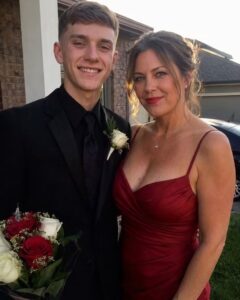
I turned, and there he was, my boy dressed in a charcoal suit, his tie slightly crooked.
“Well?” he asked, holding out his arms.
“Come here. Your boutonniere is fighting you. And your tie.”
“Jamie tried to fix it after school,” he said, glancing down. “Apparently neither of us can knot a Windsor.”
“Jamie,” I repeated, smiling because he was smiling.
The name moved past me like countless other names from countless other afternoons.
“A friend,” Austin said, and shrugged.
He came closer and let me pin the flower. Austin smelled like his father’s old cologne, the bottle I had left on the dresser and never touched again.
“You clean up all right, kid.”
“That bad, huh?
“I said all right. Don’t push it.”
Austin laughed, and that sound loosened something painful inside my chest. I had not heard him laugh like that since autumn.
“So,” I said, “do I get a name? Or am I supposed to guess?”
His gaze shifted somewhere beyond my shoulder. “She’s meeting me here.”
“Meeting you. Here. That’s bold of her.”
“Mom.”
“What? I promise to be normal. Mostly normal. I have a camera and a will to use it.”
Austin shook his head, smiling down at the floor. “Just don’t ask a thousand questions, okay?”
“No promises.”
“Mom. Please.”
“Go wait on the porch. I’ll grab the camera.”
I took it from the counter, slipped the strap around my wrist, and went outside after him. I rested against the porch rail beside my son and waited for a shy girl in a pastel dress.
Then headlights washed across the driveway.
The car door opened with a quiet click.
I raised the camera, my finger ready over the button, my smile already fixed for the teenage girl I expected to see.
But the woman who stepped out was not a teenage girl.
She was tall, in her mid-forties, wearing a dark dress far too polished for a high school gym.
Red lipstick.
A small handbag tucked beneath one arm.
For one foolish second, I thought she had come to the wrong house.
“Mom,” Austin called over his shoulder, “this is Vanessa.”
My smile locked in place.
I knew that face.