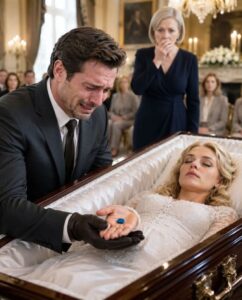
The funeral was held in a private chapel outside San Miguel.
My mother chose white flowers, soft music, and a short guest list. She wanted to control every face, every tear, every word spoken near Camila’s coffin. She had requested no photographs, no one standing too close, and a ceremony under thirty minutes.
Teresa Armenta had always mistaken elegance for innocence.
Rodrigo arrived late, wearing dark glasses and a new navy jacket. Not the same one from before.
That confirmed what I already suspected.
He was beginning to feel afraid.
I was standing beside Camila’s coffin when my mother approached.
“Julian,” she whispered through clenched teeth. “Do not ruin this.”
I looked at her.
“Ruin what, Mother? The funeral or your plan?”
Her face barely moved.
But her eyes changed.
For one second, I saw the real Teresa. Not the grieving mother. Not the respectable widow. Not the family matriarch.
A cornered woman.
“Grief is making you talk nonsense,” she muttered.
“That’s what you said yesterday.”
The priest finished a prayer. Some guests crossed themselves. Others stared at the floor, uncomfortable with a tragedy they did not understand.
When the priest asked if anyone wished to speak, my mother stepped forward.
I was faster.
“I will.”
Teresa grabbed my arm.
“No.”
I gently removed her hand.
“Yes.”
I stood before everyone. Vineyard workers. My father’s old business partners. Camila’s friends. Women from her prenatal classes. And in the third row, notary Salcedo sat sweating in the cold chapel.
I took a breath.
“Camila deserved a truthful goodbye.”
My mother stiffened.
“Julian, this is not the time.”
I looked directly at her.
“No. This is exactly the time.”
I reached into my pocket and pulled out the button.
Then I held it up.
Rodrigo stepped back.
“What are you doing?”
“Saying goodbye to my wife.”
A murmur passed through the chapel.
“This button was in Camila’s hand when I came home. Not in a report. Not in an evidence bag. In her hand. She tore it from the person who was with her before she died.”
Rodrigo gave a fake laugh.
“That proves nothing.”
“Not yet.”
I nodded toward the entrance.
The chapel doors opened.
Two ministerial agents entered with a prosecutor from Querétaro, Dr. Ana Lucía Méndez, and a forensic expert carrying a laptop.
My mother went pale.
Notary Salcedo stood as if he might leave, but an officer moved beside his row.
“This is disrespectful,” Teresa said loudly. “We are at a funeral.”
The prosecutor answered calmly.
“We are at a location connected to an investigation involving homicide, document forgery, coercion, and concealment of a minor’s identity.”
The word minor landed heavily in the chapel.
Rodrigo stared at me.
“Minor?”
I walked toward him slowly.
“My son is alive.”
I will never forget his face.
It was not relief.
It was terror.
And that terror said more than any confession.
My mother opened her mouth, but no words came out.
The prosecutor connected Camila’s recovered phone to the chapel screen. The image was shaky, but clear enough. Camila’s labored breathing filled the room.
Then Rodrigo’s voice echoed through the chapel.
“Sign it, Camila. Julian will never know.”
Someone gasped.
Then my mother’s voice followed.
“When the baby is born, we’ll say it was a complication. No one questions a grieving mother.”
Several people turned toward Teresa in horror.
In the recording, Camila barely managed to say,
“My son does not belong to you.”
Rodrigo shouted, “It’s fake!”
Dr. Ana Lucía stepped forward.
“No. The file has chain of custody, date, location, audio authentication, and forensic recovery. The medical findings also contradict the story given by the family.”
My mother tried to walk toward the exit.
An officer stopped her.
“Teresa Armenta, you are being detained for probable involvement in homicide, document falsification, coercion, and attempted concealment of a minor’s identity.”
“I did everything for this family!” she screamed.
Her voice cracked against the chapel walls.
I looked at her without moving.
“No. You did it for money.”
Rodrigo tried to shove past an officer. It was desperate and clumsy. Within seconds, they had him pinned against a wooden bench. His sunglasses fell to the floor.
The man who had always acted untouchable began to cry.
“Julian,” he said, his voice breaking. “You don’t understand. Mother said if that baby was born, everything would be over.”
“Yes,” I replied. “Your theft would be over.”
The prosecutor showed another folder.
“There are transfers to notary Salcedo, altered hospital records, an attempted cremation without autopsy, and DNA evidence recovered from the victim. Rodrigo Armenta is also under arrest.”
The notary collapsed onto the bench.
“I didn’t know she would die,” he stammered. “They only asked me to prepare paperwork.”
Teresa turned on him furiously.
“Be quiet!”
But it was too late.
The chapel had already seen the crack open.
The family had heard the truth.
And Camila, whom they thought they had silenced, had left more power in one small button than they had in all their wealth and names.
When they took my mother away, she screamed my name.
“Julian! I am your mother!”
For the first time in my life, that sentence held no power over me.
I looked at Camila’s coffin.
“And she was my wife.”
I did not smile.
Justice does not bring back a hand’s warmth. It does not rebuild laughter. It does not fill an empty room.
But sometimes justice is the only thing left to keep love from being buried twice.
Six months later, the house no longer smelled of candles or lies.
I took down the black curtains and opened every window. I sold the furniture my mother had chosen and filled the living room with plants, sunlight, and photographs of Camila smiling with her hair loose, exactly the way she loved.
Rodrigo awaited trial in custody. Teresa tried to blame him for everything, but her own statements only made things worse. Salcedo lost his license and agreed to cooperate with prosecutors.
The stolen shares were returned—not to me, but to the foundation Camila had dreamed of creating for pregnant women without family support.
I named it after her.
The Camila Ríos Foundation.
Every morning, I carried Mateo into the garden. He was still small, but strong. He had his mother’s eyes and held my finger with the same stubborn grip that had saved him.