Takht-e Rostam or Stupa of Takht-e Rostam is a stupa Buddhist monastery complex in Haibak, Afghanistan. Built in the 3rd-4th century AD while the area was part of the Kushano-Sasanian Kingdom, the complex is carved entirely from the bedrock and consists of five chambers, two of them sanctuaries. One of them has a domed ceiling with an elaborate lotus leaf decoration. On an adjacent hill is the stupa, surmounted by a harmika, with several more rough caves around the base. Unlike most stupas, the one of Takht-e Rostam has not been mounted above ground, but it has been carved into the ground, in a style that resembles the monolithic churches of Ethiopia.
Unlike most stupas, the one of Takht-e Rostam has not been mounted above ground, but it has been carved into the ground
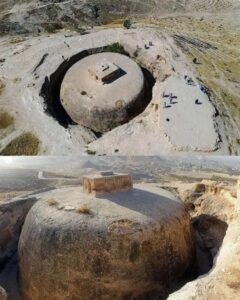
At the top of the stupa is a stone-carved, right-angled Harmika building, which once contained relics of the Buddha. The depth of the trench surrounding the stupa is about eight meters. Inside the walls surrounding the stupa is a Buddhist monastery with five individual caves and several monastic cells for meditation. Small holes in the roofs allow a little daylight to enter the caves, creating a peaceful atmosphere of twilight. It is still not exactly known why this stupa was dug. Historians have proposed two possible reasons, as to why the stupa has been carved in the ground, instead of being built above ground. One explanation is that it could have been done for the purpose of camouflage to protect the monastery from invaders. Another much more mundane explanation states that it has simply been done to escape the excessive climate extremes of Afghanistan.
At the top of the stupa is a stone-carved, right-angled Harmika building, which once contained relics of the Buddha
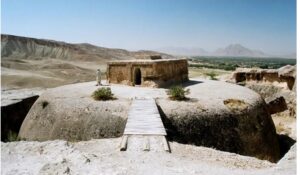
View of the stupa and the old plank bridge to the Harmika building. Image Credit: tedchang.free.fr
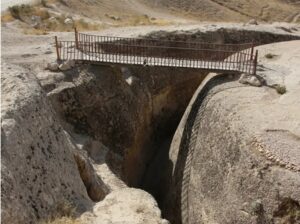
The new bridge and the trench. Image Credit: Michal Hvorecky via Wikipedia
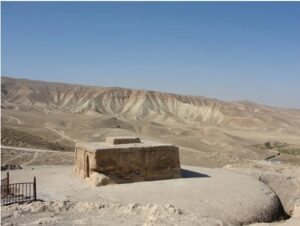
Image Credit: Michal Hvorecky via Wikipedia
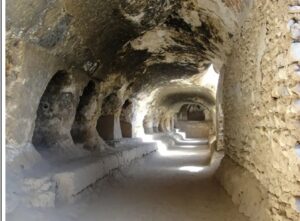
Below Buddhist stupa is a series of five caves, former monks’ cells for meditation. Image Credit: Michal Hvorecky via Wikipedia