For twenty years, my husband claimed the woman tattooed above his heart had never truly existed. I nearly believed him—until an old photograph slipped from a hidden compartment in his garage, and the six words written on the back led me toward someone I had never been meant to find.
The photograph slid from beneath a loose panel in Richard’s toolbox and landed face-up on the garage floor.
At first, all I noticed were its faded, yellowing edges.
Then I saw the woman.
She was younger than the face tattooed across Richard’s chest, but the eyes matched.
So did the tiny rose behind her left ear.
She held a premature infant inside a neonatal unit.
Her eyes were not on the camera. She was gazing down at the baby with complete tenderness.
On the back, Richard had written six words.
“Forgive me, Rose. She can’t know.”
Twenty years earlier, during our honeymoon, Richard had walked out of the hotel bathroom with a towel wrapped around his waist.
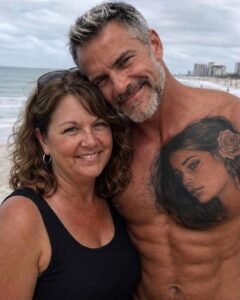
It was the first time I had seen him shirtless long enough to notice the tattoo.
A beautiful young woman looked up from his chest.
Dark hair fell over one shoulder.
Behind her ear was a rose no larger than a thumbnail.
“Who is she?” I asked.
Richard glanced down as though he had forgotten the tattoo existed.
“Nobody.”
“Nobody gets tattooed over your heart, Richie.”
He laughed and pulled me into his arms. “She’s nobody you know. I had it done years ago.”
I trusted him completely.
I held onto that explanation through five unsuccessful fertility treatments. I clung to it again when the doctor gently advised us to stop trying.
But I believed him most deeply on the morning we carried home a premature baby girl with dark eyes, a fierce cry, and a cream-colored blanket tucked around her tiny legs.
I searched the toolbox once more.
Beneath a tray filled with screws, I discovered a black address book with a cracked spine.
Nearly every number had been crossed out, but one name remained untouched.
Rose.
My thumb hovered over the number.
Then I called from our landline.
The phone rang five times.
“Hello?” a woman answered.
Her voice sounded older and guarded.
Silence stretched between us.
“Richard?” she whispered, apparently recognizing the number. “Is that really you?”
I tightened my grip on the receiver’s tangled plastic cord.
“This isn’t Richard. It’s his wife.”
On the other end, I heard a cup touch a hard surface.
Then she started crying.
“You finally found me,” she said. “I thought this day would never come.”
“Who are you?”
Rose remained silent.
Her breathing gradually steadied.
“I can’t tell you over the phone.”
“You can tell me right now.”
“No.” Her voice remained gentle. “Some truths should not arrive without a face attached to them.”
She gave me the address of a diner in the neighboring town.
I took the photograph and left before Richard returned home. My hands trembled so badly that I missed the turn twice.
Rose was waiting in the final booth.
Her hair had turned silver, but I recognized her instantly.
She held a coffee cup between both hands.
“You’re Evelyn,” she said.
Her fingers became still.
I set the photograph between us.
Rose lowered her eyes to it. Her shoulders dropped, as though a burden had suddenly become lighter.
Before she could respond, the bell above the diner entrance rang.
Richard stepped inside.
He noticed me first.
Then he saw Rose.
All the color drained from his face.
He did not resemble a husband caught meeting a lover.
He looked like a man who had finally reached the end of an old promise.
Rose started to rise, then settled back into the booth.
“I called him,” she told me.
Then she faced Richard.
“Did you keep it?”
Richard removed his coat but remained standing.
“Every day.”
He reached inside his wallet and removed a folded square of paper. Its creases were so worn they had become nearly transparent.
He placed it beside the photograph.
Rose did not reach for it.
I unfolded the note.
“Promise me she’ll always grow up believing she was wanted. Never make her feel like someone gave her away.”
I read it twice.
Then I looked at Richard.
He slid into the booth beside me, leaving several inches between us.
Neither he nor Rose spoke.
The waitress approached with a coffeepot, glanced at our faces, and quietly turned away.
“Richard?”
He kept his eyes on the note.
“Claire,” he replied.
The name landed softly, yet everything inside me shifted.
Rose slowly turned her cup in circles.
I looked between them.
“Is Claire your daughter?”
The response came immediately.
“Is she Rose’s daughter?”
Rose turned toward the window.
“No,” Richard answered.
He ran one thumb along the edge of the old note.
“Rose was the neonatal nurse who quietly changed the way I understood compassion years before I ever met you.”
For several seconds, I could not fit those words into the version of the story I had already constructed.
I had imagined an affair.
A hidden daughter.
Richard bringing another woman’s child into our home while I thanked him for agreeing to adopt.
I had never imagined a nurse.
Rose stared into her coffee.
“Claire was born more than ten weeks early,” she said. “She spent almost four months in the neonatal unit.”
“You know what the agency told you, Evelyn.”
“They said she had been abandoned shortly after birth,” I choked out.
Rose’s spoon tapped the saucer.
“No one came back for her,” she whispered.
The noises of the diner seemed to swell around us.
Rose continued quietly.
“She was so small that she could only wrap two tiny fingers around the tip of mine. She hated the monitoring leads. She worked one foot out of the blanket no matter how tightly we tucked her in.”
A faint smile touched her mouth.
“The other nurses called her stubborn.”
“What did you call her?” I asked.
I looked again at the photograph.
Rose had not been looking toward the camera. Her entire attention had been fixed on Claire with the same absorbed expression I wore during midnight feedings, when the house was silent and my daughter’s whole life seemed to rest against my shoulder.
Rose lowered her cup onto its saucer.
“Because babies need to be held, even when nobody has arrived yet.”
The answer softened the shape of my anger, though it did not erase it.
Richard unfolded the note again and carefully flattened it.
“Rose sang to her during procedures,” he recalled, his expression gentler. “She read beside the incubator. She celebrated every ounce Claire gained.”
At the time, Rose had also been caring for her terminally ill mother.
She spent nights working at the hospital and her days sitting beside her mother’s bed. Her apartment had only one bedroom, and nearly all her savings went toward rent and medication.
When Claire became available for adoption, Rose asked whether she could apply.
“I thought loving her might be enough,” she said.
It was not.
The social worker explained that Rose lacked the space, financial security, and support system required to care for a medically fragile infant.
“So you stepped aside?” I asked.
Rose watched rain trace lines down the window.
“I was pushed aside by facts. Stepping aside was what I chose afterward.”
Richard rested his hand beside the photograph.
Memories returned to me in pieces.
A discharge room painted pale green.
Claire sleeping inside a carrier.
A nurse tucking the cream blanket around her.